Mathematics
Curriculum Objectives
Our Mathematics curriculum aims to develop students’ interest, understanding and acquisition of mathematical concepts and computational skills. Students learn mathematics in an engaging environment where they actively explore and experiment through discussions while working on mathematical activities. Through real-life and hands-on experience, observation and discussion, our Mathematics programme facilitates student learning in mathematical concepts and problem-solving skills in a stimulating environment. Students are guided to:
- Develop logical thinking and reasoning skills
- Acquire mathematical concepts through hands-on activities
- Learn to ask insightful questions and share the process of solving problems
- Apply creative thinking and communication skills
Curriculum Framework
Our Mathematics programme is a spiral curriculum in which topics and materials are revisited repeatedly over months and across grades. The Mathematics topics are across five strands: Number, Shape and Space, Measures, Data Handling and Algebra.
Key Stage 1
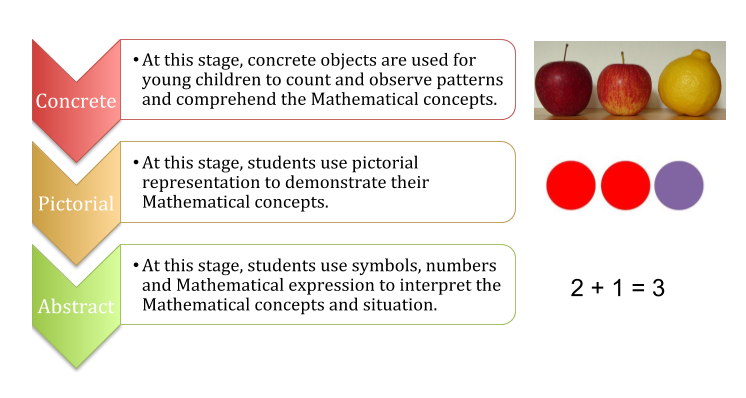
In key stage 1, our junior students learn about numbers, shapes and different operations to comprehend and interpret daily phenomena. Through observation, concrete hands-on experience, discussion and daily practice, our young learners can develop number sense and spatial sense and apply the knowledge and skills they have learnt.
Key Stage 2
In key stage 2, students learn to operate with fractions, decimals and percentages. They can create and draw 2-D and 3-D shapes. They find the perimeters and areas of shapes by applying a formula. They measure the volume, capacity and speed of objects. They learn to plot complicated charts and diagrams to interpret and explain a phenomenon. They also work with symbols and algebras to investigate the relationship between numbers and operations.
Assessment
Assessment is a routine part of the ongoing classroom activity. Our students are assessed formatively and summatively. Module tests are carried out at the end of each module to review and reflect on students’ learning. Mid-term and term-end assessments are carried out at the middle and end of each term.
Subject Highlights
Math Week
Our students enjoy solving and creating Math puzzles and games inside and outside the classrooms. Every year, students create Math puzzles, riddles and games for their classmates to solve. Through creation, students apply knowledge and skills to build, adapt, categorise, explain and interpret Math concepts.


Manipulatives for Learning
Manipulatives are widely used in our Math lessons because we believe our children are intuitive learners. Through hands-on activities, young children cognitively develop their own number sense and spatial sense.


IT in Math


Students' Achievement
Many of our students are Math prodigies, and their achievements outside school are very impressive. Throughout the years, they have won numerous awards from different competitions, such as the Guangdong-Hong Kong-Macao Greater Bay Area Mathematical Olympiad, the Hong Kong 4D Frame Maths & Science Creativity Competition, the Hua Xia Cup Nationwide Mathematical Olympiad Invitation Tournament, etc.


Every year, our students participate in the ICAS International Examination. Look at our medalists and students who have high distinction!


